Showing posts with label educational and informational topics. Show all posts

Friday, March 9, 2018

Quilt 'Til You Wilt Days and A Few Other Favorite Things

I just love those days when I wake up with nothing on my schedule. After a leisurely breakfast followed by a steaming cup of my favorite tea, I decide what I want to do for the day. 


Most often, on these "free" days, I choose to quilt. Because I have the whole day in front of me, I can "quilt 'til I wilt." (I borrowed that phrase from a quilt shop, Tiny Stitches, in Marietta, Georgia. An eight hour group sewing day called "Quilt 'Til You Wilt" is offered once a week at this shop.) I have had a few of these quilt 'til you wilt days at my own sewing machine in recent weeks, and the product of those days is a quilt top that is about 3/4 complete. The quilt consists of just three fabrics and some whopping 18 inch blocks. Here you will see a partial view of my mostly completed quilt top featuring some of my favorite colors.


Pattern: Dream On designed by Jocelyn Ueng from Quiltmaker March/April 2013

I paused in my quilting to travel for a long weekend. My husband and I drove a little more than two hours to a neighboring state. Our main reason for choosing this particular weekend was to hear our favorite singer/songwriter, Peter Mayer. Peter is from Minnesota, but just once in a while he travels to perform in the southeast. We try to catch his concerts when they are within a few hours of where we live. The lyrics to his songs range from inspiring to nostalgic to funny. He is a master on the guitar, and his voice is engaging and quite pleasant, like no other songwriter I've heard. Below is a sampling of Peter's work, a song he wrote called "Dorothy's Pie" from his CD Novelties. The song references a true story about his mom and dad, and it is one of my favorites. My husband spoke to Peter during the intermission and unbeknownst to me requested this song, knowing it was a favorite of mine. During the second half of the concert, Peter honored the request, and so I was able to hear him sing it in person, much to my delight!


Among the activities during our long weekend was a visit to Congaree National Forest. As you may know from previous posts, visiting national parks is one of my favorite parts of traveling. We didn't know quite what to expect since this newer national park is smaller and not very well-known. We were pleasantly surprised as we walked a 2.5 mile boardwalk through beautiful vistas of trees and water. 


Several rivers drain into this area causing flooding at least once a year. It was interesting to see trees that flourish in this environment and to learn about the benefits of the flooding that bring necessary nutrients to this wilderness area. 


We chose a good time of year to visit this particular national park. Because of the abundance of water and the heat during the summer months, mosquitoes can be a major problem in the park. We were glad that the posted mosquito meter was only at a "1" during our visit in early March.


Back home now from my long weekend away, it's time to think about spring, one of my favorite seasons (the other favorite being fall). Even though it is not officially spring, the daffodils in our yard are in full bloom. 


Just like this time last year, the snap peas, lettuce, spinach, and broccoli are planted in our garden, and a few stalks of asparagus are pushing through the earth. I'm eager for the time coming soon when I can walk into the backyard and harvest these favorite spring vegetables to use in a healthy and delicious meal.


Over the years, I have enjoyed collecting pottery. My husband was recently gifted a new piece of pottery made by Peg Morar of Asheville, NC. It is a unique piece in shades of blue and sage green with dots of red. This may have become my favorite piece of pottery that we own. I immediately placed it on our dining room table along with a quilted table runner in coordinating colors.


So, when will I have another of those favorite quilt 'til you wilt days? Well, I'm not sure since very soon I will be at another of my favorite places--a quilt and sewing expo. Stay tuned as I might just share that experience in a future blog post. In the meantime, please leave a comment and share a few of your favorite things!

I have received no compensation for the mention of items or companies in this blog post. All opinions are my own.

Wednesday, March 7, 2018

Curiosity

Quilting is a passion of mine, but at the same time, it is a calming and meditative activity for me. I sometimes listen to favorite podcasts while I'm in front of my sewing machine. Other times, as I've mentioned in a previous blog post, my time spent quilting gives me time to think about all kinds of topics. Quilting in combination with listening and reflecting often leaves me with new insights.


I have been sewing a lot lately, working on a new quilt top. It's a simple pattern using only three fabrics, so it's been a perfect time to ponder topics that come to mind. 

Curiosity has been at the forefront of my consideration in the past few days. My husband and I recently attended an event where the theme was curiosity. Although the speaker for the event was pleasant and personable, I felt he didn't cover the topic of curiosity in a very convincing way. What the event did, however, was to spur my own thinking about this subject.  

Just the word curiosity takes me back to my teaching days. What I wanted most for my students was for them to become life-long learners. I truly believe that maintaining a sense of wonder and curiosity fuels a desire for learning during one's entire lifetime. On occasion, I asked my students to find and share a few "wow facts" which were facts that made them stop and think, "Wow, that's amazing!" As these wow facts were shared, there were a lot of wide eyes filled with wonder and curiosity (including mine). This assignment gave me insight into the topics that engaged my students' curiosity. 


As we know, curiosity seems to come naturally to humans. We can witness this natural curiosity in toddlers and young children as they explore their world and ask many questions, including the famous "Why?" that many young children continue asking until their understanding is satisfied. As children grow older, it seems that some of that natural curiosity gets drowned out with other parts of life sometimes getting in the way. The question then becomes how we can rediscover our natural curiosity as adults. I have a few suggestions:

  • Slow down and take time to allow for wonder.
  • Show interest in others and their pursuits.
  • Know that there is always something new to learn.
  • Make a point of being around others who voice their wonder, curiosity, and amazement.
  • Find activities or hobbies that spur creativity and innovation.
  • Spend time in nature where it's so easy to be amazed by awe-inspiring sights and sounds. (Many of those wow facts shared by my students related to nature.)


To close, I will share a few quotes about curiosity:


The important thing is to not stop questioning. Curiosity has its own reason for existing.
                                                        --Albert Einstein

We keep moving forward, opening new doors, and doing new things, because we're curious, and curiosity keeps leading us down new paths.
                                                       --Walt Disney

Once we believe in ourselves, we can risk curiosity, wonder, spontaneous delight, or any experience that reveals the human spirit.
                                                       --e.e. cummings


Tuesday, January 23, 2018

Word Play

Do you like to read or write? Are word games like Scrabble your favorite? Do you find the humor in puns, plays on words, or limericks? Do others look to you to edit their papers or essays? If so, you may be high in verbal intelligence as part of Howard Gardner's multiple intelligences. 


Howard Gardner is the John H. and Elisabeth A. Hobbs Professor of Cognition and Education at the Harvard Graduate School of Education. He is also an adjunct professor of psychology at Harvard University. Gardner may be best known for his theory of multiple intelligences where he challenges the assumption that there is only one kind of intelligence. Instead his widely accepted theory states that there are at least eight different intelligences. 

Howard Gardner

Let's get back to all those questions at the beginning of this blog post that relate to verbal intelligence, one of Gardner's eight intelligences. Verbal is not my strongest intelligence on the multiple intelligence quiz, but it scores a close second. I really enjoy words, and my latest quilting project reflects that love of words. 

For an annual fee, I subscribed for a few years to a quarterly newsletter from the fabric company Benartex. The newsletter came along with some new fabric samples from the company. The fabric was always cut into charm squares (5 inch squares), and the newsletter contained information about new lines of fabric as well as one or two patterns that could be made using the charm squares. When I received a packet of charm squares a couple of years ago named "Word Play" I set it aside knowing that one day I would make a small quilt from the squares. Well, the day has arrived to make that quilt and use some of that fabric in limbo that I mentioned in a previous post.

The pattern for this fabric featured in the newsletter is a little scrappier than I usually make, meaning that the colors don't necessarily coordinate the way in which I usually choose fabric. There are browns, blacks, grays, whites, creams, and greens among the squares. The common bond among the fabrics is that they feature words having to do with quilting, and since I love words, I'm going with the scrappy pattern that is featured.

I start by cutting each of the charm squares in half to make what quilters call a half square triangle (HST).  


Charm Square

Cutting Half Square Triangles

Hafl square triangles cut from "Word Play" by Benartex Fabrics

Following the pattern, I mix and match the HST's to lay out small quilt blocks all around my sewing machine. 


Then I begin to stitch the HST's together, and after that I sew the individual quilt blocks together. 

So now the quilt top is ready for the backing, quilting, and binding. It has been such a pleasure to combine my love of words with my passion for quilting by using this Word Play fabric. 

What about you? Do you believe yourself to be high in verbal intelligence? Or is another of Gardner's multiple intelligences one with which you identify? Does your work or your hobby reflect one of your intelligences? Please leave a comment and share your thoughts.

I have received no compensation for the mention of fabric or companies in this blog post. All opinions are my own.

Linked with: Freemotion by the River Linky Tuesday, Over the Moon, Wonderful Wednesday, Needle and Thread Thursday, Thursday Favorite Things

Wednesday, November 22, 2017

The Latest Trend

Butterflies Galore

As I visited fabric stores and viewed fabric online recently, I noticed what must be a trend. Many fabrics now feature butterflies. I even decided to use butterfly fabric to make a fabric bowl.


A while back I bought a fabric jelly roll, which consists of color coordinated precut 2 1/2 inch strips of fabric ready to use in a quilt or project. I had fun looking at different patterns trying to decide how to use my jelly roll. Then I watched a YouTube video by Jenny Doan of  Missouri Star Quilt Company as she described a new butterfly quilt pattern.


When I found that the butterfly pattern uses a fabric jelly roll, my decision was made. At some point in 2018, I hope to made a butterfly quilt out of my jelly roll of purples and teals.


Galaxy Pixie Strips jelly roll by RJR Fabrics

Fascination with butterflies goes back as far as ancient Greek culture. In our culture, butterflies are often symbolic of transformation, life's transitions, hope, freedom, or beauty. Butterflies have a way of bringing both children and adults to a standstill. When coming upon a butterfly in nature, a sense of delight prevails. It's easy to become silent and wonder-filled when observing butterflies in a butterfly house or an active butterfly garden. 


Our fascination with butterflies extends to literature as well. Eric Carle's book, The Very Hungry Caterpillar, is a classic book popular with preschool and elementary school teachers as well as parents of young children. Its vivid colors and engaging text introduce children to the life stages of a butterfly. This lovely book has inspired fabric designers so that many fabric stores now carry a line of The Very Hungry Caterpiller fabric by Andover Fabrics. 
The Very Hungry Caterpillar by Andover Fabrics


While speaking of butterflies and literature, I would recommend the novel, Flight Behavior by Barbara Kingsolver. This book extends the enjoyment and knowledge of butterflies through an intriguing story.


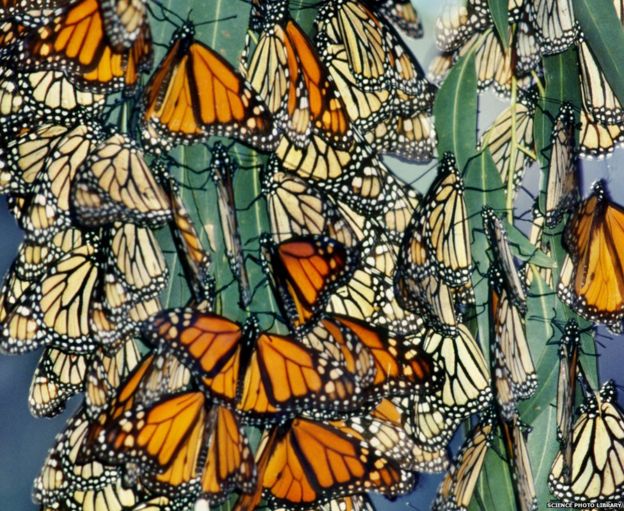
Many of us may associate butterflies with spring and summer when we are aware of their presence and beauty as they flutter from blossom to blossom. However, fall is an important time as adults of the eastern population of monarch butterflies migrate to Mexico, flying up to 3,000 miles. In the western U.S., monarchs migrate to groves along the coast of California. 


Monarch butterflies overwintering in California
Monarch butterflies overwintering in California, Source: Science Photo Library

According to BBC news, in 2004 an estimated 550 million monarch butterflies arrived at their usual wintering ground. But 10 years later, in 2014, there were just 50 million - a decline of about 90%. Some scientists believe that these sensitive butterflies are victims of climate change, and these same scientists are watching the plight of the butterflies as an indicator of a warming earth. I know local environmentalists who are encouraging the planting of milkweed, the monarch larvae's food source, in backyards and community gardens. This is one strategy thought to help increase the population of these beautiful creatures.


Purple Milkweed

I have found plenty of inspiration for quilts and other fabric projects featuring butterflies. On a recent trip to the North Carolina Arboretum, my husband and I visited a small butterfly house. We watched a few varieties of butterflies, including monarchs, as they flew through the enclosure, stopping momentarily to sip nectar from the abundance of butterfly friendly plants. 


The Arboretum's quilt garden is one of my favorite places. Colorful plants are arranged in such a way as to mimic quilt blocks. There are steps nearby which allow visitors to look down upon the quilt blocks to see the entire quilt garden display. Much to my delight on this particular visit, the quilt garden was full of butterfly quilt blocks. It truly must be the year of the butterfly!


Are you a fan of butterflies? What do butterflies symbolize for you? Please leave a comment and share your thoughts.

I have received no compensation for the mention of books, fabric, or companies in this blog post. All opinions are my own.

Linked with: Over the Moon, Freemotion by the River

Saturday, October 28, 2017

A Visit to National Parks

Kaweah River, Sequoia National Park

My husband and I recently traveled to Nevada where my brother-in-law and sister-in-law live. The four of us then traveled together to Sequoia National Park and Kings Canyon National Park near Fresno, California. These parks are located in the Sierra Nevada mountain range and at 6,000-7,000 feet in elevation are home to huge sequoia trees. Sequoia trees are some of the largest and oldest organisms on earth. The largest of the sequoias are as tall as a 26 story building, and many of these trees have a diameter of at least 20 feet. Sequoia bark can be 3 feet thick and is resistant to fire, insects, and disease. These trees can live up to 3,500 years, and they continue to grow throughout their life span. 


After traveling on narrow, winding roads for several miles within Sequoia National Park, we finally reached an elevation where sequoia trees grow. There was a collective gasp in the car as we first viewed these dramatic trees mixed with smaller trees rich with autumn color. We decided to travel on through the park to the famous General Sherman tree. We parked and walked for a while to reach the tree that is noted as the largest living tree on the planet.  At 2,100 years old, it weighs 2.7 million pounds, is 275 feet tall and has a 102-foot circumference at the ground. It has branches that are almost 7 feet in diameter. 


General Sherman Tree, Sequoia National Par

A couple of days later we traveled about two hours north to Kings Canyon National Park. Here we viewed more of these majestic trees in their mountainous setting. The General Grant tree is a tourist draw in this park and is the second largest tree by volume on earth. Notice the vivid blue sky on our lovely autumn day in this park.


General Grant Tree, Kings Canyon National Park
Even though these parks are connected, Kings Canyon National Park is my favorite of the two. We took a 1 1/2 mile hike in this national park that was incredibly tranquil and beautiful.  The natural setting around the trees is magnificent, and there are other amazing sites such as this fallen sequoia which visitors can walk through. 


Fallen Monarch Tree, Kings Canyon National Park

I don't always return from our trips with souvenirs, but at the visitor center in Sequoia National Park, I couldn't resist when I found a special quilting treasure. These small fabric panels will be perfect when stitched into a quilted tote bag or two and will be special reminders of a special trip.


Design by American Quilt Blocks
Our travels often take us into different national parks, but I'll have to say that these particular parks do not disappoint with their majestic trees and lovely vistas. At the same time, I find myself wondering where our next national park trip will take us.

Do you have a favorite national park or natural setting that you enjoy visiting? Where do your travels take you? Please leave a comment and share your thoughts.

Linked with: Marilyn's Treats

Monday, October 2, 2017

Making and Canning Applesauce


Fall in the mountains of western North Carolina always means a trip to a nearby apple orchard. My husband and I travel to our favorite orchard in a nearby county where we view and sample the varieties offered. 


We almost always drift back to our favorites--Mutsu for cooking and Pink Ladies for eating. The Pink Lady variety is not quite ready yet, but the Mutsu apples are abundant. 

After visiting the orchard, we set aside a day each fall to make and can applesauce. Our first step is to wash the apples. Then we core, peel, and cut the apples into pieces that will help the cooking process go more quickly.


Adding a small amount of water, we cook and stir for a while until the apples break down, soon resembling applesauce. We could stop the cooking at this point if we wanted chunky applesauce, but we usually cook it down until we have a smoother texture.


Normally, after taking the applesauce off the stove, we spend some time using a potato masher, continuing to break up the last bits of apple. However, this year my husband had an idea. He said, "Why not use the immersion blender to break up the apples and get the desired texture?" What a great idea! And it worked perfectly!! In only a few seconds using the immersion blender, we had exactly the texture we prefer. It does pay to be careful when using the immersion blender, however, since just a few seconds too long might result in the texture of baby food.


Now that the applesauce is finished, it's time to begin the canning process. With clean and sterilized jars, lids, and rings, we use a funnel to fill the jars. It's important to keep the edges of the jars free of any drips of applesauce and to tighten the lids and rings as much as possible.


Our pressure canner will hold seven pint jars at a time, so we fill the canner with the jars and begin the process of canning. It only takes a few minutes in the canner to seal those lids.


We repeat this canning process several times until we have 28 pints of applesauce! It has taken a bushel of those Mutsu apples and a whole day, but it is rewarding to look at all those jars of applesauce cooling on our kitchen counter. Applesauce, anyone?

Linked with: Marilyn's Treats

Friday, February 24, 2017

Sit Back and Relax--All You Need Is a Book

Wit, Wisdom, Intrigue--It's All There

(No payment or compensation of any kind has been received for books and articles mentioned in this post. All writing/opinions are my own.) 

You have to write the book that wants to be written. And if the book will be too difficult for grown-ups, then you write it for children.
                                                   --Madeleine L'Engle, author

A children's story that can only be enjoyed by children is not a good children's story in the slightest.
                                                  --C.S. Lewis, author

Writing a picture book is like writing "War and Peace" in Haiku.
                                                    --Mem Fox, author

Years ago, I participated in a weekend seminar in a nearby town. The keynote speaker started the first session by reading aloud a children's picture book. I knew at that moment this was going to be a good seminar. This speaker knew the value of using children's literature with adults. 

I have been an avid reader since childhood, and I have never outgrown my love of children's literature. In my last blog post, I mentioned how even children's picture books can be powerful and poignant. It is my deep belief that children's literature is often not just for children. Adults can find great stories, humor, and wisdom by reading children's books. So for today's post, I would like to feature some books for children that I would recommend to adults. Some of these selections are "oldies but goodies", but all are available at libraries and in book stores.


The Giver by Lois Lowry
I'm a retired educator, and this was one of my favorite books to use with fifth graders. Discussions of this book were always deep and rich. And it never failed when I assigned this book, parents of my students would read it as well, become intrigued with the book, and then would call or email me wanting to get in on the discussion! This book deals with the theme of safety vs. freedom--an appropriate topic for our current culture. Lois Lowry has written two companion books, Gathering Blue and The Messenger. These books continue the story and the intrigue.

Quotes from books by Lois Lowry
"It's the choosing that's important, isn't it?"

"Even trained for years as they all had been in precision of language, what words could you use which would give another the experience of sunshine?"


From the Mixed-Up Files of Mrs. Basil E. Frankweiler by E. L. Konigsburg
This charming book is adventurous and includes a twist toward the end of the book that rivals any books written for adults. Mrs. Frankweiler, a memorable character, is full of wisdom and wit. 

Quotes from books by E. L. Konigsburg
"Happiness is excitement that has found a settling down place, but there is always a little corner that keeps flapping around."

"I think you should learn, of course, and some days you must learn a great deal. But you should also have days when you allow what is already in you to swell up inside of you until it touches everything. And you can feel it inside of you. If you never take time out to let that happen, then you accumulate facts, and they rattle around inside of you. You can make noise with them but never really feel anything with them. It's hollow."

"The eyes are the windows of the soul...If someone was to look into your eyes, what would you want them to see?"


A Wrinkle in Time by Madeleine L'Engle
This book is the winner of the 1963 Newbery Award for the best children's book of the year. It is full of fanciful adventures as the characters solve a mystery in their own space and time. It will engage the imagination of adults as well as children. This book is part of a series which also includes A Wind in the Door, A Swiftly Tilting Planet, and Many Waters.

Quotes from books by Madeleine L'Engle
"Life, with its rules, its obligations, and its freedoms, is like a sonnet: You're given the form, but you have to write the sonnet yourself."

"Maybe you have to know the darkness before you can appreciate the light."

"We can't take any credit for our talents. It's how we use them that counts."

"The great thing about getting older is that you don't lose all the other ages you've been."

"Stories make us more alive, more human, more courageous, more loving."


Bud, Not Buddy and The Watsons Go To Birmingham-1963 by Christopher Paul Curtis
To read these two award winning books is to be transported back in time to the Great Depression (in Bud, Not Buddy) and to both America's Great Migration and the Civil Rights Movement (in The Watsons Go To Birmingham). This very talented author allows readers to view history through the lives of believable and endearing characters. These are powerful, not to be missed, books. 

Quotes from books by Christopher Paul Curtis
"A bud is a flower-to-be. A flower in waiting. Waiting for just the right warmth and care to open up. It's a little fist of love waiting to unfold and be seen by the world. And that's you."

"Things aren't ever what they seem to be when you first look at them. What's important is to keep your mind wide open and try to understand what's going on from a lot of different angles."


Esperanza Rising and When Marian Sang by Pam Munoz Ryan
This prolific author has written many notable books, but these are two of my favorites. Esperanza Rising is the story of a family forced by a tragedy to leave their home in Mexico and emigrate to California during the Great Depression. A beautiful picture book illustrated by Brian Selznick, When Marian Sang is the story of Marian Anderson. The book focuses on Marian's childhood dreams and the struggle it took for Marian to realize those dreams as an adult in a segregated country. 

Quotes from books by Pam Munoz Ryan
"We are like the phoenix...rising again with a new life ahead of us."

"Oh...I think my heart is dancing."

"How many others were walking around and not even knowing that someone far away cared for them? Imagine all that love floating in the air, waiting to land on someone's life."

"Music does not have a race or a disposition. Every instrument has a voice that contributes. Music is a universal language...Music surpasses all distinctions between people."

"Everybody has a heart. Sometimes you gotta work hard to find it."

"The words he had written wriggled off the page and escaped from the drawer. The letters stacked themselves, one on top of the other. Their towers reached higher and higher until they stood majestic and tall...HUMANITY. SOLIDARITY. GENEROSITY. PEACE. JUSTICE. LOVE. Then a tiny, conceited word came along. Like a hungry termite, it began to gnaw on the tall words, chewing at their foundation, gulping their pulp until they swayed, toppled, and collapsed. All that remained was one fat, satisfied syllable. FEAR."


The Trellis and the Seed: A Book of Encouragement for All Ages by Jan Karon, paintings by Robert Gantt Steele
Jan Karon is absolutely one of my favorite authors. Most people know her for her Mitford series books, but she has also writtten a few picture books for children. This simple, yet beautiful, story is definitely a treat for both children and adults as the subtitle implies. 

Quotes from Jan Karon's The Trellis and the Seed
"It was only a seed, and very, very small. How could it ever be a beautiful vine with blossoms?"

"Just start...The job is half done when you've made a beginning."

Other memorable children's books recommended for adults:

  • The Eagle and the Wren by Jane Goodall--a fable retold beautifully by this author and anthropologist
  • Feathers and Fools by Mem Fox--a powerful picture book that is suitable for older children and adults
  • Of Thee I Sing: A Letter to My Daughters by Barack Obama--a delightful book recommended for individuals and families

                
Do you have any favorite children's books? What lessons have you learned from reading children's books? Please leave a comment and share your thoughts.

While writing this post, I found and read an article, posted on The Week's Best Stories from NPR Books, about the percentage of characters in children's books that are people of color as of 2016. You can read the article here.

Note: The blog post title is a quote from Dr. Seuss.

Linked with:
Marilyn's Treats